Hey there! As a supplier of Manifold Tail Pieces, I'm super stoked to dive into the different types of connections available for these nifty little components. Manifold Tail Pieces are like the unsung heroes in a whole bunch of systems, connecting various parts and making sure everything runs smoothly. So, let's get right into it!
Threaded Connections
One of the most common types of connections for Manifold Tail Pieces is threaded connections. Threaded connections are great because they're easy to install and provide a tight seal. You can find different thread types, like NPT (National Pipe Thread) and BSP (British Standard Pipe).
NPT threads are widely used in North America. They have a tapered design, which means they get tighter as you screw them in. This creates a really good seal, and it's perfect for applications where you need to prevent leaks. For example, in plumbing systems, NPT-threaded Manifold Tail Pieces are used to connect pipes and fixtures.
On the other hand, BSP threads are more common in Europe and other parts of the world. There are two types of BSP threads: BSPP (Parallel) and BSPT (Tapered). BSPP threads are parallel, and they usually require a sealing compound to prevent leaks. BSPT threads, like NPT, are tapered and provide a better seal without the need for additional sealing materials.
Threaded connections are super versatile. You can use them in all sorts of industries, from HVAC (Heating, Ventilation, and Air Conditioning) systems to hydraulic systems. If you're looking for a reliable and easy-to-install connection for your Manifold Tail Piece, threaded connections are definitely a top choice.
Flanged Connections
Flanged connections are another popular option for Manifold Tail Pieces. Flanges are flat, circular discs with holes around the edge. They're bolted together to create a strong and secure connection. Flanged connections are great for applications where you need to handle high pressures or large volumes of fluid.
There are different types of flanges, such as weld neck flanges, slip-on flanges, and socket weld flanges. Weld neck flanges are the most common type. They have a long, tapered neck that's welded to the pipe or Manifold Tail Piece. This provides a strong and durable connection that can handle high stresses.
Slip-on flanges are easier to install because they simply slide over the pipe and are then welded in place. They're a good choice for applications where you need a quick and easy installation. Socket weld flanges are similar to slip-on flanges, but they have a socket that the pipe fits into. This provides a more precise and secure connection.
Flanged connections are commonly used in industries like oil and gas, chemical processing, and power generation. If you're working in an industry where safety and reliability are crucial, flanged connections for your Manifold Tail Pieces are a great option.
Compression Connections
Compression connections are a popular choice for Manifold Tail Pieces in smaller systems or applications where you need a quick and easy installation. Compression connections work by using a compression nut and a ferrule to create a seal between the pipe and the Manifold Tail Piece.
The compression nut is tightened onto the ferrule, which then compresses against the pipe. This creates a tight seal that prevents leaks. Compression connections are easy to install and don't require any special tools or welding. They're also easy to disassemble if you need to make any changes or repairs.
Compression connections are commonly used in plumbing systems, refrigeration systems, and small-scale hydraulic systems. They're a great option if you're looking for a simple and cost-effective way to connect your Manifold Tail Pieces.
Welded Connections
Welded connections are the most permanent and strongest type of connection for Manifold Tail Pieces. Welding involves melting the metal of the pipe and the Manifold Tail Piece together to create a single, solid piece. This provides a very strong and leak-proof connection.
There are different types of welding processes, such as TIG (Tungsten Inert Gas) welding, MIG (Metal Inert Gas) welding, and arc welding. TIG welding is a precise and clean welding process that's often used for small and delicate Manifold Tail Pieces. MIG welding is faster and more suitable for larger Manifold Tail Pieces. Arc welding is a more traditional welding process that's commonly used in industrial applications.
Welded connections are commonly used in industries where high strength and reliability are required, such as aerospace, automotive, and heavy machinery. If you're working in an industry where safety and performance are critical, welded connections for your Manifold Tail Pieces are the way to go.
Specialized Connections
In addition to the common types of connections, there are also some specialized connections available for Manifold Tail Pieces. For example, some Manifold Tail Pieces are designed to be used with Switch Valve Manifold. These connections are specifically designed to work with the unique features of the switch valve manifold, such as its flow control and switching capabilities.
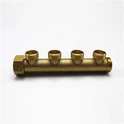
Another example is the Four Way Brass Manifold. Manifold Tail Pieces used with four-way brass manifolds need to have connections that can handle the multiple flow paths and directions. These connections are often designed to provide a tight seal and smooth flow of fluid.
Flowmeter manifolds, like the Flowmeter Manifold, also require specialized connections. These connections need to be able to accurately measure the flow of fluid and provide a stable and reliable connection.
Choosing the Right Connection
So, how do you choose the right connection for your Manifold Tail Piece? Well, it depends on a few factors. First, you need to consider the application. What kind of system are you using the Manifold Tail Piece in? Is it a high-pressure system, a low-pressure system, or a system that requires precise flow control?
You also need to consider the fluid or gas that will be flowing through the Manifold Tail Piece. Some fluids, like chemicals or corrosive substances, may require a special type of connection that can resist corrosion.


Another factor to consider is the installation process. Do you have the tools and skills to install a welded connection, or do you need a simpler, more user-friendly connection like a threaded or compression connection?
Finally, you need to consider the cost. Some connections, like welded connections, can be more expensive because they require specialized equipment and skills. Other connections, like threaded or compression connections, are more cost-effective.
Conclusion
As you can see, there are many different types of connections available for Manifold Tail Pieces. Each type of connection has its own advantages and disadvantages, and the right choice depends on your specific application and requirements. Whether you need a threaded connection for a simple plumbing system, a flanged connection for a high-pressure industrial system, or a specialized connection for a unique application, we've got you covered.
If you're in the market for Manifold Tail Pieces and need help choosing the right connections, don't hesitate to reach out. We're here to provide you with the best products and expert advice to ensure your system runs smoothly. Let's start a conversation about your project and find the perfect Manifold Tail Piece connections for you!
References
- "Pipe Fittings Handbook" by Cameron Iron Works
- "Welding Handbook" by American Welding Society
- Industry standards and guidelines from relevant organizations such as ASME (American Society of Mechanical Engineers) and ASTM (American Society for Testing and Materials)