Can brass manifolds be used in high - pressure systems? That's a question I get asked a lot as a brass manifolds supplier. Let's dive right into it and see what the deal is.
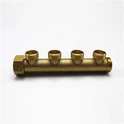
First off, brass is a pretty tough material. It's an alloy made mainly of copper and zinc, and this combination gives it some great properties. Brass is known for its good corrosion resistance, which is super important in many industrial applications. It can handle a fair amount of wear and tear, and it's also relatively easy to machine. This means we can make all sorts of complex shapes and designs for our brass manifolds, like the Temperature Control Manifold, Switch Valve Manifold, and Four Way Brass Manifold.
Now, when it comes to high - pressure systems, there are a few things to consider. High - pressure systems can be found in a variety of industries, such as oil and gas, hydraulics, and aerospace. These systems require components that can withstand a lot of force without failing.
Brass manifolds do have some limitations in high - pressure scenarios. The strength of brass is not as high as some other materials like stainless steel or carbon steel. In very high - pressure applications, say those with pressures above 3000 psi (pounds per square inch), brass might start to show signs of stress. It could deform, crack, or even burst if the pressure gets too extreme.
However, that doesn't mean brass manifolds can't be used in high - pressure systems at all. For medium - high pressure applications, typically in the range of 1000 - 3000 psi, brass manifolds can be a great choice. They offer a good balance between cost, corrosion resistance, and performance.
One of the advantages of using brass manifolds in these medium - high pressure systems is their cost - effectiveness. Brass is generally less expensive than stainless steel or other high - strength alloys. This makes it a more budget - friendly option for companies that need to outfit their systems with multiple manifolds.
Another benefit is the ease of installation and maintenance. Brass is a soft material compared to some others, so it's easier to cut, drill, and thread. This means that installing and modifying brass manifolds is a relatively straightforward process. If there's a problem with a manifold, it can be repaired or replaced more easily and at a lower cost.
Let's take a look at some real - world examples. In a small - scale hydraulic system used in a manufacturing plant, the operating pressure might be around 1500 psi. A brass manifold can handle this pressure just fine. It can distribute hydraulic fluid to different parts of the system, allowing for precise control of the machinery. The corrosion resistance of brass also ensures that the manifold will last a long time without getting clogged or damaged due to rust.
In the HVAC (heating, ventilation, and air conditioning) industry, brass manifolds are often used in refrigerant systems. These systems typically operate at pressures in the 200 - 500 psi range. Brass manifolds are well - suited for this application because they can handle the pressure while also resisting the corrosive effects of refrigerants.
But how do you know if a brass manifold is right for your high - pressure system? You need to do a thorough analysis of your system's requirements. Consider the maximum operating pressure, the temperature of the fluid or gas in the system, and the chemical composition of the fluid. You also need to think about the environment in which the manifold will be installed. If it's in a harsh, corrosive environment, you might need to take extra precautions to protect the brass.
One way to increase the reliability of brass manifolds in high - pressure systems is to use proper design and manufacturing techniques. At our company, we use advanced CNC (computer numerical control) machining to ensure that our manifolds have precise dimensions and smooth surfaces. This helps to reduce stress concentrations and improve the overall strength of the manifold.
We also offer different grades of brass, each with its own set of properties. Some grades are more suitable for high - pressure applications than others. For example, naval brass contains a small amount of tin, which gives it better corrosion resistance and slightly higher strength compared to standard brass.


It's also important to follow proper installation and maintenance procedures. Make sure the manifold is installed correctly, with all the connections tightened to the appropriate torque. Regularly inspect the manifold for signs of wear, corrosion, or damage. If you notice any issues, address them immediately to prevent further problems.
In conclusion, while brass manifolds do have some limitations in high - pressure systems, they can be a viable option for medium - high pressure applications. They offer a cost - effective, easy - to - install, and corrosion - resistant solution. If you're in the market for brass manifolds for your high - pressure system, we'd love to talk to you. Our team of experts can help you determine if our brass manifolds are the right fit for your specific needs. Whether you need a Temperature Control Manifold, Switch Valve Manifold, or Four Way Brass Manifold, we have a wide range of products to choose from.
If you're interested in learning more or discussing your requirements, don't hesitate to reach out. We're here to help you make the best decision for your high - pressure system.
References:
- ASM Handbook Volume 2: Properties and Selection: Nonferrous Alloys and Special - Purpose Materials
- Machinery's Handbook, 31st Edition
- Fluid Power Engineering Handbook by Heinz P. Bloch