How to Define a Smooth Manifold?
As a provider of manifold products, I've spent a significant amount of time exploring the concept of smooth manifolds. Understanding how to define a smooth manifold is not only crucial for academic research in differential geometry but also has practical implications for various industries, including ours. In this blog post, I'll delve into the technicalities of defining a smooth manifold, provide real - world examples, and explain how our manifold products relate to these mathematical concepts.
The Basics of Manifolds
Let's start with the fundamental idea of a manifold. A manifold is a topological space that locally resembles Euclidean space. In simpler terms, if you zoom in on any point of a manifold, it looks like a piece of a flat, ordinary space (like the 2 - dimensional plane $\mathbb{R}^2$ or 3 - dimensional space $\mathbb{R}^3$).
Formally, a topological space $M$ is called a topological manifold of dimension $n$ if it satisfies two main conditions:
- Hausdorff Property: For any two distinct points $p,q\in M$, there exist disjoint open sets $U$ and $V$ in $M$ such that $p\in U$ and $q\in V$. This property ensures that points in the manifold can be separated, which is a basic requirement for well - behaved spaces.
- Locally Euclidean: Every point $p\in M$ has an open neighborhood $U$ that is homeomorphic to an open subset of $\mathbb{R}^n$. A homeomorphism is a continuous function with a continuous inverse, which means that the neighborhood $U$ can be stretched, bent, and deformed continuously to match an open subset of $\mathbb{R}^n$.
From Topological to Smooth Manifolds
While topological manifolds give us a general framework for understanding spaces that are locally like Euclidean space, smooth manifolds take it a step further. A smooth manifold requires the ability to do calculus on the manifold.
To define a smooth manifold, we need to introduce the concept of an atlas. An atlas $\mathcal{A}$ on a topological manifold $M$ is a collection of charts ${(U_{\alpha},\varphi_{\alpha})}$, where each $U_{\alpha}$ is an open subset of $M$ (a coordinate neighborhood), and $\varphi_{\alpha}:U_{\alpha}\to\varphi_{\alpha}(U_{\alpha})\subseteq\mathbb{R}^n$ is a homeomorphism (a coordinate chart).
The key requirement for a smooth manifold is that the transition maps between overlapping coordinate charts are smooth. Suppose we have two overlapping coordinate charts $(U_{\alpha},\varphi_{\alpha})$ and $(U_{\beta},\varphi_{\beta})$ with $U_{\alpha}\cap U_{\beta}\neq\varnothing$. The transition map $\varphi_{\beta}\circ\varphi_{\alpha}^{- 1}:\varphi_{\alpha}(U_{\alpha}\cap U_{\beta})\to\varphi_{\beta}(U_{\alpha}\cap U_{\beta})$ is a function between open subsets of $\mathbb{R}^n$. A smooth manifold is a topological manifold with an atlas such that all transition maps are smooth, i.e., they have continuous partial derivatives of all orders.
Real - World Examples of Smooth Manifolds
Smooth manifolds are not just abstract mathematical concepts; they appear in many real - world scenarios.
One of the most well - known examples is the surface of a sphere, denoted as $S^2$. The sphere can be thought of as a 2 - dimensional smooth manifold. To see this, we can construct an atlas with at least two charts. For instance, we can use the stereographic projection. By removing the north pole and the south pole separately and projecting the remaining parts of the sphere onto the plane, we get two coordinate charts. The transition maps between these charts can be shown to be smooth, which means that the sphere is a smooth manifold.
In engineering and physics, smooth manifolds are used to model the configuration spaces of mechanical systems. For example, the set of all possible orientations of a rigid body in 3 - dimensional space forms a smooth manifold called the special orthogonal group $SO(3)$. This manifold has important applications in robotics, aerospace engineering, and computer graphics.
Our Manifold Products and Smooth Manifolds
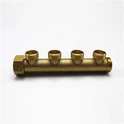
As a manifold provider, our products are designed to meet the needs of various industries where the concept of smoothness and local Euclidean - like behavior is essential. Our manifolds are used in electrical systems, and one of our popular products is the Copper Wiring Terminal.
In electrical engineering, the distribution of electrical signals through a manifold can be thought of as a process that follows the principles of smoothness. The smoothness of the electrical connections and the flow of current are crucial for the efficient operation of the system. Our copper wiring terminals are engineered to ensure a smooth and stable connection, which is analogous to the smooth transition maps in the mathematical definition of a smooth manifold.
The Importance of Defining Smooth Manifolds in Our Business
Understanding the concept of smooth manifolds helps us in several ways. Firstly, it allows us to design products that are more efficient and reliable. By ensuring that our manifold products have smooth connections and transitions, we can minimize electrical resistance and signal loss.
Secondly, it helps us communicate better with our customers, especially those in industries where mathematical concepts are highly valued. When discussing the performance of our products, we can use the language of smoothness and local Euclidean - like behavior to explain the advantages of our designs.
Contact Us for Manifold Procurement
If you are interested in our manifold products, especially our Copper Wiring Terminal, we invite you to contact us for procurement and further discussions. Whether you are in the electrical engineering, robotics, or any other industry that requires high - quality manifold products, we have the expertise and the products to meet your needs. We are committed to providing you with the best solutions and ensuring that our products live up to the standards of smoothness and reliability.
References
- Spivak, M. (1970). Calculus on Manifolds: A Modern Approach to Classical Theorems of Advanced Calculus. Benjamin/Cummings Publishing Company.
- Lee, J. M. (2012). Introduction to Smooth Manifolds. Springer.
- Do Carmo, M. P. (1992). Riemannian Geometry. Birkhäuser.