Alright, so you're probably wondering, "How do you integrate over a manifold?" Well, I'm here to break it down for you in a way that's easy to understand. And as a Manifold supplier, I've got some real - world insights to share.
First off, let's talk about what a manifold is. In simple terms, a manifold is a geometric object that locally resembles Euclidean space. Think of it as a surface or a shape that, if you zoom in close enough, looks like a flat plane. For example, the surface of a sphere is a two - dimensional manifold. Even though it's curved overall, if you take a tiny patch on it, it can be approximated as a flat piece.
Now, when it comes to integration over a manifold, it's not like the regular integration we learn in basic calculus. In standard calculus, we're integrating over intervals on the real line. But with manifolds, we're dealing with more complex geometric structures.
One of the key concepts in integrating over a manifold is the idea of a differential form. A differential form is a mathematical object that allows us to measure things like volume, area, or flow on a manifold. It's a way to assign a number to each little piece of the manifold, and then we can sum up these numbers to get the integral.
Let's take a simple example of a one - dimensional manifold, like a curve in space. To integrate a function over this curve, we first need to parameterize the curve. That means we find a way to describe every point on the curve using a single variable, say (t). For instance, if we have a curve (C) in three - dimensional space, we can write (x = x(t)), (y = y(t)), and (z = z(t)) for (a\leq t\leq b).
The integral of a function (f(x,y,z)) over the curve (C) is then given by (\int_{C}f(x,y,z)ds=\int_{a}^{b}f(x(t),y(t),z(t))\sqrt{(x^\prime(t))^{2}+(y^\prime(t))^{2}+(z^\prime(t))^{2}}dt). Here, (ds) represents an infinitesimal arc length along the curve, and we calculate it using the derivatives of the parameterization functions.
For higher - dimensional manifolds, things get a bit more complicated. Consider a two - dimensional manifold, like a surface (S) in three - dimensional space. We usually parameterize the surface using two variables, say (u) and (v). So, (x = x(u,v)), (y = y(u,v)), and (z = z(u,v)) for ((u,v)) in some region (R) in the (uv) - plane.
The integral of a function (g(x,y,z)) over the surface (S) is (\iint_{S}g(x,y,z)dS=\iint_{R}g(x(u,v),y(u,v),z(u,v))\left|\frac{\partial\vec{r}}{\partial u}\times\frac{\partial\vec{r}}{\partial v}\right|dudv), where (\vec{r}(u,v)=x(u,v)\vec{i}+y(u,v)\vec{j}+z(u,v)\vec{k}), and (\frac{\partial\vec{r}}{\partial u}\times\frac{\partial\vec{r}}{\partial v}) is the cross - product of the partial derivatives of the position vector (\vec{r}) with respect to (u) and (v). The magnitude (\left|\frac{\partial\vec{r}}{\partial u}\times\frac{\partial\vec{r}}{\partial v}\right|) gives us the infinitesimal area element (dS) on the surface.
Now, as a Manifold supplier, the products we offer can be used in various applications where manifold integration is relevant. For example, in engineering and physics, when dealing with fluid flow over a curved surface or heat transfer on a non - planar object, we often need to perform these types of integrals.
One of our popular products is the Copper Wiring Terminal. This terminal is made of high - quality copper, which has excellent electrical conductivity. It can be used in manifold - related electrical systems, such as in circuits that are integrated on a curved or non - standard surface. The design of the terminal ensures a secure connection, which is crucial in applications where precise electrical measurements and calculations are required.
In the field of mathematics, manifold integration is also used in differential geometry and topology. These areas of study help us understand the fundamental properties of manifolds, like their curvature and connectivity. And in turn, these mathematical concepts have applications in computer graphics, robotics, and even in the study of the universe's structure.
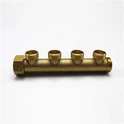
If you're working on a project that involves manifold integration, you might be wondering how our products can fit into your needs. Well, our manifolds are designed with precision to ensure that they can be easily incorporated into your system. Whether you're dealing with a simple one - dimensional curve or a complex three - dimensional manifold, our products can provide the stability and functionality you require.
Let's say you're an engineer working on a project to design a heat exchanger with a non - planar surface. You'll need to calculate the heat transfer rate over the surface, which involves integrating a function over the manifold representing the surface. Our manifolds can be used to build the structure of the heat exchanger, and the Copper Wiring Terminal can be used for any electrical connections related to sensors or control systems in the exchanger.
Another example is in the field of robotics. When a robot moves along a curved path, the path can be considered a one - dimensional manifold. To calculate things like the robot's energy consumption or the forces acting on it during the motion, you'll need to perform integration over this manifold. Our products can be used in the robot's construction, providing the necessary mechanical and electrical components.
If you're interested in learning more about how our manifold products can be used in your manifold - integration projects, or if you want to discuss specific requirements, we're here to help. We have a team of experts who can answer your questions and guide you through the selection process. Whether you're a researcher, an engineer, or a student, we value your input and are eager to work with you.
In conclusion, manifold integration is a powerful mathematical tool with a wide range of applications in various fields. And as a Manifold supplier, we're committed to providing high - quality products that can support your projects. So, if you think our products might be a good fit for your needs, don't hesitate to reach out and start a conversation about procurement. We're looking forward to working with you to achieve your goals.
References
- Spivak, M. (1965). Calculus on Manifolds: A Modern Approach to Classical Theorems of Advanced Calculus.
- Do Carmo, M. P. (1976). Differential Geometry of Curves and Surfaces.